Fiber optic vs cable internet : which to choose in 2026 ?
Contents
Torn between fiber optic (FTTH) and cable internet (DOCSIS) for your subscription or to wire up a building ? Both technologies still coexist in 2026, but they no longer play in the same league.
Coaxial cable (CATV) wired millions of homes in the 1990s-2000s for television, then for Internet via the DOCSIS standard. Fiber optic arrived gradually and took over : higher speed, lower latency, incomparable reliability. This guide compares the two technologies on four technical criteria (speed, distance, bandwidth, reliability) and on practical aspects (cost, deployment, availability).
Fiber and cable : two distinct technologies
Both carry digital data, but their physical medium is radically different :
- Coaxial cable : a copper conductor surrounded by a metallic sheath. Carries a modulated electrical signal (DOCSIS 3.0 / 3.1 / 4.0).
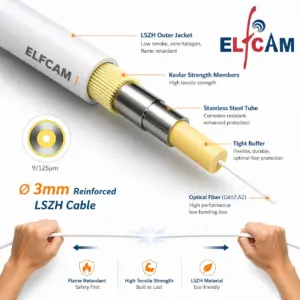
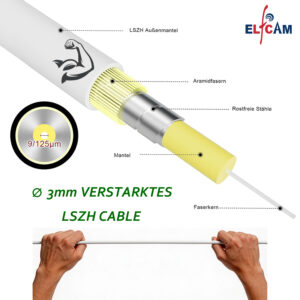
- Fiber optic : a glass or plastic core (single-mode 9/125 µm or multimode 50/125 µm) that guides a light signal through total internal reflection.
In France, the cable network (historically deployed by Numericable, today SFR) covers around 9 million sockets. FTTH fiber optic now exceeds 38 million connectable sockets and keeps expanding. To dig deeper into architectures, see our article on FTTP, FTTH, FTTC, FTTx.
Speed : why fiber crushes cable
| Technology | Downstream speed | Upstream speed | Symmetry |
|---|---|---|---|
| FTTH GPON fiber | up to 2.5 Gbps | 1.25 Gbps | Near-symmetric |
| FTTH XGS-PON fiber | 10 Gbps | 10 Gbps | Symmetric |
| DOCSIS 3.0 cable | 100-500 Mbps | 5-50 Mbps | Highly asymmetric |
| DOCSIS 3.1 cable | 1-2 Gbps | 100-500 Mbps | Asymmetric |
| DOCSIS 4.0 cable | 10 Gbps (rare) | 6 Gbps (rare) | Symmetric |
Technically, the propagation speed of the electrical signal and the optical signal are nearly identical (~2/3 of the speed of light in a vacuum). The difference comes from the usable bandwidth and the signal degradation.
The cable's electrical signal suffers from electromagnetic interference (EMI), thermal attenuation and transmission errors that increase with distance. The optical signal, immune to EM fields, keeps its speed stable over tens of kilometres. The longer the coaxial cable, the more amplifiers are needed — each one adding noise and jitter.
Distance and range
In single-mode fiber optic, a Gigabit signal travels several tens of kilometres without a repeater. With long-distance SFP modules (LR, ER, ZR), links reach 40, 80 or even 120 km. This is why all international backbones are fiber — including transatlantic submarine cables.
Copper Ethernet (twisted pairs Cat 5/6/7) is limited to 100 m by the ANSI/TIA-568 standard. DOCSIS coaxial cable requires amplifiers every few hundred metres. At equivalent distance, fiber consumes less energy and requires less maintenance.
Pro tip : extending a LAN beyond 100 m
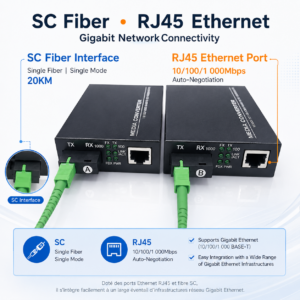
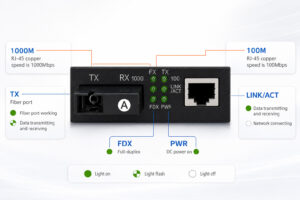
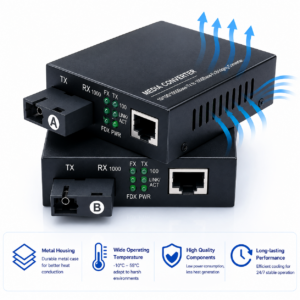
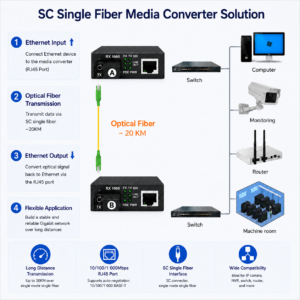
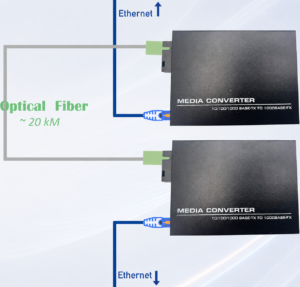
Need to run a network from your house to a workshop 200 m away ? Copper Ethernet won't do it. A fiber Ethernet converter with SFP lets you cross up to 20 km over single-mode fiber, for a few tens of euros per end. Much simpler and more reliable than a series of intermediate switches.
Available bandwidth
A medium's bandwidth depends directly on the frequency it can carry :
- Twisted pairs : frequencies up to 500 MHz (Cat 6), 2 GHz (Cat 8)
- Coaxial cable : up to ~1.2 GHz (DOCSIS 3.1) or 1.8 GHz (DOCSIS 4.0)
- C-band fiber optic : 1530-1565 nm, i.e. ~4.4 THz — roughly 2000 times more than DOCSIS 4.0
Fiber has such a bandwidth reserve that today's consumer speeds (1-10 Gbps) use only a tiny fraction of the medium. Labs are now testing 400 Gbps per wavelength and 100+ Tbps with DWDM multiplexing.
Reliability and resilience
Fiber is inherently more reliable :
- Immune to lightning and surges : no electrical conductor in the cable core
- Immune to EM interference : runs next to a motor or a high-voltage line without degradation
- Temperature tolerance : -40 to +85 °C with no loss of performance (coaxial cable : noticeable drift above 50 °C)
- No bandwidth sharing : FTTH GPON fiber shares up to 32 subscribers per port, versus 500-2000 homes on DOCSIS (hence the evening speed drop on cable)
- Lifespan : 25-30 years for single-mode fiber, vs 10-15 years for outdoor coaxial
Cable users regularly experience 25% drops at peak hours. FTTH fiber, with its properly sized point-to-multipoint architecture, hardly ever has this problem.
Cost and availability in France
On the end-subscriber side, prices have converged :
- FTTH fiber 500 Mbps - 1 Gbps : €20-40/month at Free, Orange, SFR, Bouygues
- Fiber 2-8 Gbps : €40-60/month (Freebox Ultra, Orange Pro, Bouygues Pure Fibre)
- SFR Power cable : €25-45/month — only available on the historical Numericable network
At the deployment level, fiber costs more to install the first time (trenches, splices), but operating costs are lower : fewer amplifiers to maintain, fewer interventions, longer lifespan. In rural areas, fiber is now almost everywhere (the France Très Haut Débit target reached in 2025-2026) and is even replacing legacy DSL.
Still not eligible for fiber ?
In areas where fiber has not yet arrived (about 2 million sockets at the end of 2025), Starlink or a 4G/5G box are credible temporary alternatives. Elfcam also offers Starlink accessories to optimise these installations.
Elfcam FTTx solutions
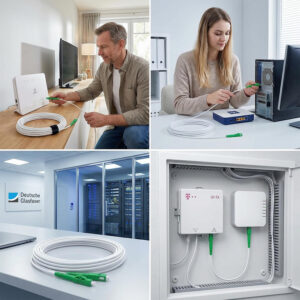
For a complete fiber deployment (house, building, hotel, office), Elfcam supplies the entire FTTH chain :
Recommended fiber equipment
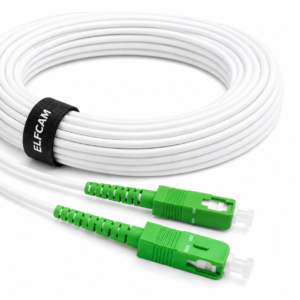
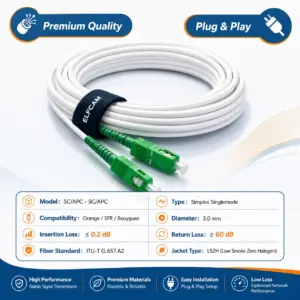
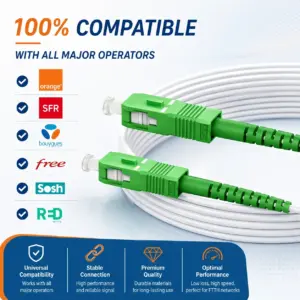
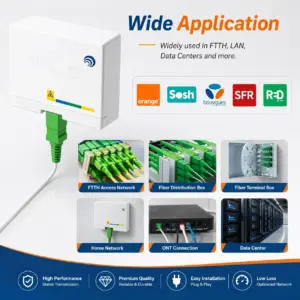
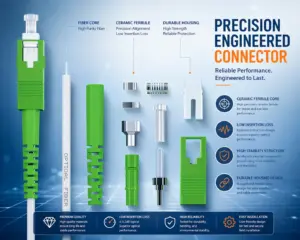
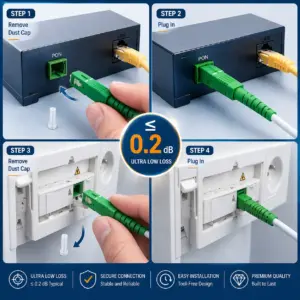
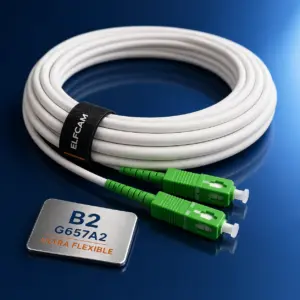
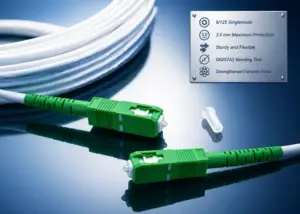
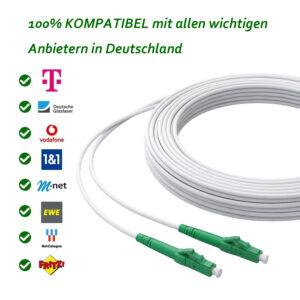
- Reinforced single-mode SC/APC OS2 patch cord — compatible with Freebox, Orange Livebox, SFR Box, Bouygues Bbox
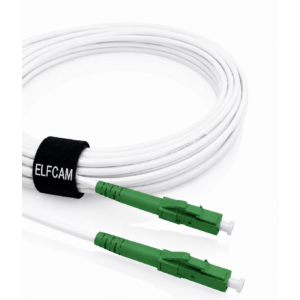
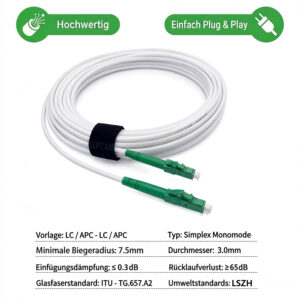
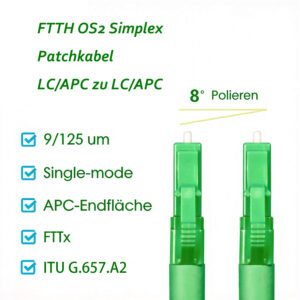
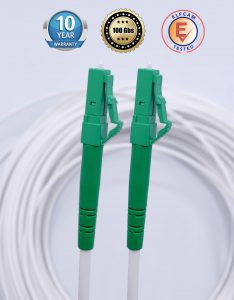
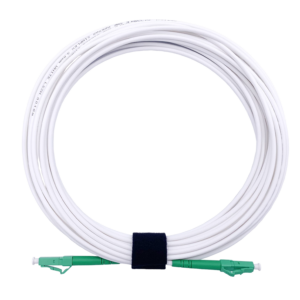
- LC/APC single-mode LSZH patch cord — for datacenter equipment and patch panels
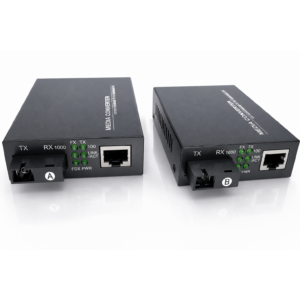
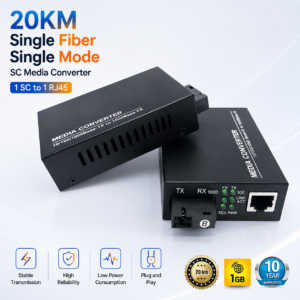
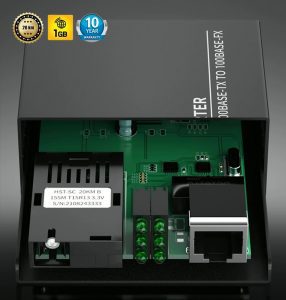
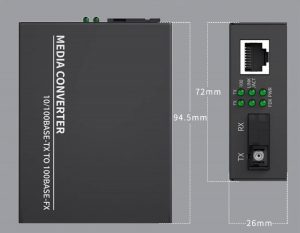
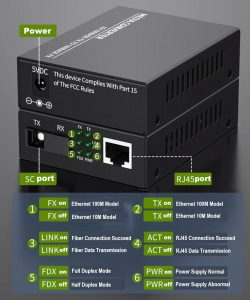
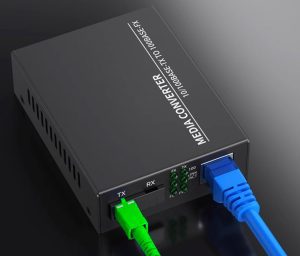
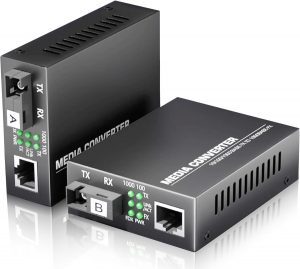
- Fiber Ethernet converter 1.25 G SC 20 km — point-to-point link < 20 km
- Fiber cable catalogue — patch cords, pigtails, reinforced outside cable
- PLC splitters 1:8 to 1:64 — for hotel/residential PON deployment
- SFP BiDi, LR, ER modules — all distances and speeds


Hotel use case : POL (Passive Optical LAN)
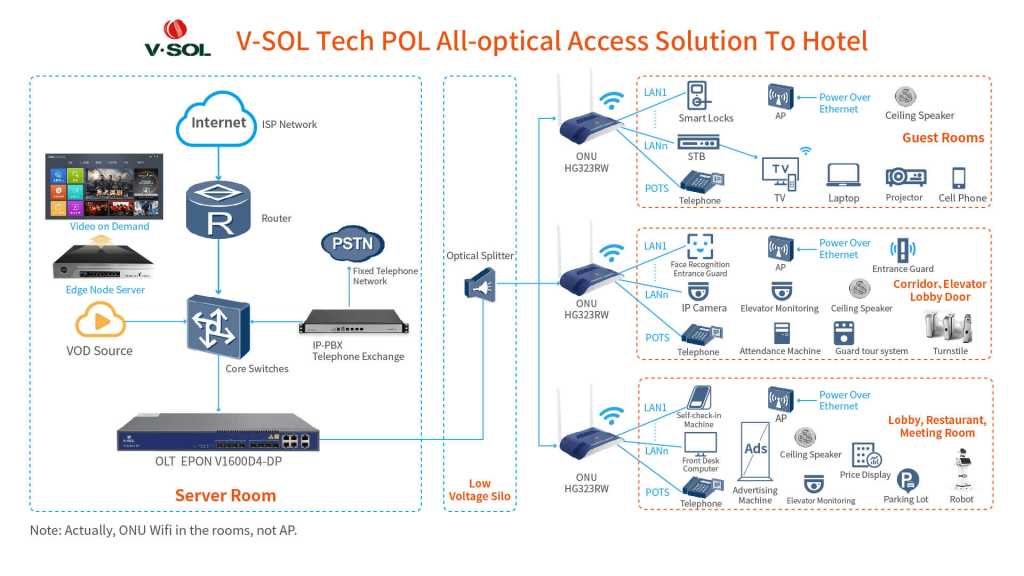
POL replaces a hotel's traditional Ethernet cabling with a PON architecture :
- 1 room = 1 fiber to a central splitter, far thinner and more discreet than a Cat 6 bundle
- 1 device = multiple services : internet, WiFi, VoIP, CATV, connected locks
- Flexibility : adding a room no longer requires pulling the LAN back to the technical room
- Operating savings : less active equipment, less power consumption
FAQ — Fiber vs cable
1Is fiber always faster than cable ?
2Cable = coaxial or Ethernet ?
3Is SFR cable (ex-Numericable) really fiber ?
4Is latency better with fiber ?
- FTTH fiber : 1-5 ms to French servers
- DOCSIS cable : 10-30 ms
- ADSL : 30-60 ms
- 4G : 30-80 ms
- Satellite (excluding Starlink) : 500-700 ms
5Can I plug any box into fiber ?
6Is fiber fragile ?
7Fiber or fixed 5G for a rural home ?
8Delivery and warranty on Elfcam fiber equipment ?
In summary
In 2026, fiber optic outclasses coaxial cable on every technical criterion : speed, symmetry, distance, bandwidth, reliability, latency. Cable has only a temporary advantage on legacy networks (SFR ex-Numericable) as long as the FTTH migration is not complete.
If fiber is eligible at your address, choose it. For a professional deployment (hotel, residence, house, datacenter), our Home Fiber range and our fiber converters cover every topology, from a simple point-to-point to a complete PON architecture.