Advantages and disadvantages of optical fiber in telecoms

Contents
Optical fiber has become the standard for modern telecommunications: residential FTTH, datacenter, enterprise networks, submarine cables. But like any technology, it has its decisive advantages and its specific disadvantages.
This guide details the 6 key advantages (bandwidth, distance, security…) and the 4 limitations (fragility, cost, installation) of optical fiber transmission to help you make the right infrastructure choices.
What is optical fiber transmission?
Optical fiber transmission consists of carrying information in the form of light signals through a silica waveguide (the core of the fiber). The signal travels by total internal reflection between the core (high index) and the cladding (lower index).
This principle enables:
- Very low loss per kilometer (0.2 dB/km at 1550 nm)
- Exceptional bandwidth (THz available)
- Total immunity to electromagnetic interference
The 3 components of a fiber system
| Component | Role | Technologies |
|---|---|---|
| Optical transmitter | Converts electrical signal → light | LED (short-distance multimode), Laser (single-mode), VCSEL (datacenter) |
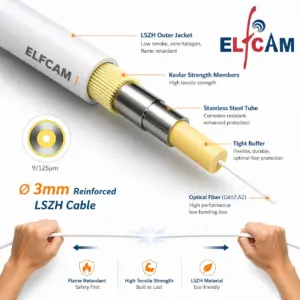
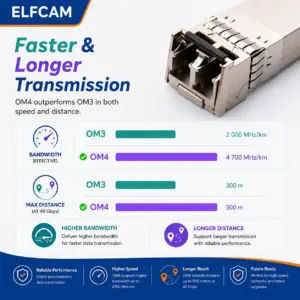
| Fiber cable | Carries the light signal | Single-mode OS2, multimode OM3/OM4, simplex/duplex |
| Optical receiver | Converts light signal → electrical | PIN photodiode, APD (avalanche) |
The 6 advantages of optical fiber
1. Exceptional bandwidth
No other wired medium matches fiber: THz of bandwidth theoretically. In practice: 100 Gbps per wavelength, up to 80 simultaneous wavelengths with DWDM = 8 Tbps per fiber. Cat 8 copper cable tops out at 40 Gbps over 30 m.
2. Very long distance without amplification
0.2 dB/km at 1550 nm on single-mode OS2: a 100 km link loses only 20 dB. Cat 6 copper loses 35 dB over 100 m. Transatlantic submarine cables (5000+ km) use fiber + EDFA only.
3. Total electromagnetic immunity
Fiber carries light, not electricity: indifferent to radio waves, electric motors, lightning, frequency drives. Critical for:
- Industrial environments (proximity to motors, welding)
- Hospitals (MRI, sensitive medical equipment)
- Military sites (resistance to EMP pulses)
- Links crossing electrically noisy areas
4. Unmatched physical security
No electromagnetic radiation "leaks" from the fiber: impossible to eavesdrop without physically cutting it. On copper, a parasitic signal can be induced remotely (Tempest). This is why sensitive government and banking links use fiber + encryption.
5. Lightness and compactness
A 9/125 µm fiber weighs ~6 g/km. A 144-fiber multi-strand cable weighs less than a single equivalent Cat 6 cable. Crucial for overloaded cable trays in datacenters and for aerial deployments (poles).
6. Future-proof
Fiber installed today will support tomorrow's 100G, 400G, 800G rates by changing only the optical modules at the ends. Copper requires replacing the entire installation to go from Cat 5e to Cat 8.
The 4 disadvantages to know
1. Installation difficulties
Fusion splices require:
- An optical fiber fusion splicer (€3,000-15,000)
- A cleaver, stripper, cleaning kit
- A trained technician (minimum 2 weeks of training)
- Pre-spliced connectors (pigtails) or manual polishing
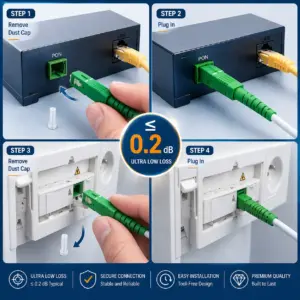
For simple installations (pre-terminated patch cords), an individual can do it; for splices, you need a certified installer.
2. Mechanical fragility
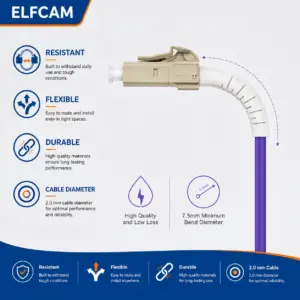
Fiber is made of silica glass: 125 µm in diameter, breaks if bent below a 5 mm radius (except G.657.B3). Risks:
- Cut during trenching work (rodents, mechanical shovels)
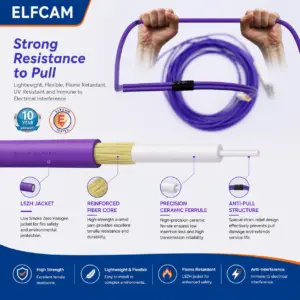
- Internal breakage under excessive tension
- Degradation by hydrogen gas (chemical aging)
- Deterioration in submarine environments (pressure, marine life)
For a robust installation
Use G.657.B3 bend-insensitive fiber (5 mm radius without loss) and steel-armored cable for outdoor or buried runs.
3. Attenuation and dispersion over long distances
Beyond 80-100 km, the signal weakens and distorts (chromatic dispersion). Solutions:
- EDFA (Erbium-Doped Fiber Amplifier) — optical amplifier without electrical conversion
- 3R regenerators (Reshape, Retime, Reamplify) for very long distances
- Dispersion compensation (DCM, DCF) to correct distortion
Notable additional cost but bearable given the performance delivered.
4. Higher hardware cost
Indicative comparison:
- Cat 6 cable 50 m: €30
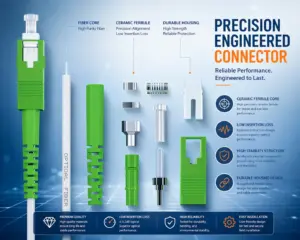
- OS2 fiber cable 50 m + 2 SC/APC connectors: €40-60
- SFP+ 10G fiber module: €50-150
- RJ45 10G module: €30-80
The gap narrows every year. For large volumes, fiber becomes competitive.
Fiber vs copper comparison (Cat 6/Cat 8)
| Criterion | Optical fiber OS2 | Copper Cat 6A |
|---|---|---|
| Max throughput | 10-400 Gbps+ | 10 Gbps |
| Distance @ 10G | 10-80 km | 100 m |
| Attenuation | 0.22 dB/km | 35 dB/100 m |
| EMI immunity | Total | Low (shielding needed) |
| Security (eavesdropping) | Very high | Medium (radiation) |
| Weight 100 m | ~600 g | ~3500 g |
| Cable diameter | 3-5 mm | 7-8 mm |
| Installation | Specialized technician | Simple crimping |
| Initial cost | Moderate-high | Low |
| Future-proof | 25-30 years | 10-15 years |
When to choose optical fiber?
Choose fiber if…
- Distance > 100 m between devices (impossible on Cat 6)
- Throughput > 10 Gbps required (10G, 40G, 100G+)
- Hostile EMI environment (industrial, hospital, military)
- Critical security (governmental, banking)
- Future-proofing expected (25+ years of use planned)
- Inter-building link (lightning immunity)
Copper is enough if…
- Distance < 100 m and throughput ≤ 10G
- Very tight budget for a temporary project
- Team with little fiber training
- No EMI constraint or high security need
Elfcam optical fiber solutions
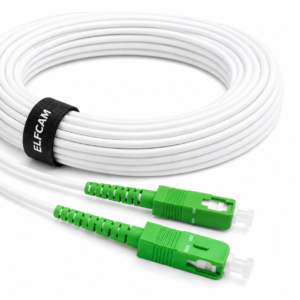
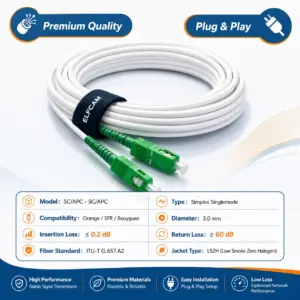
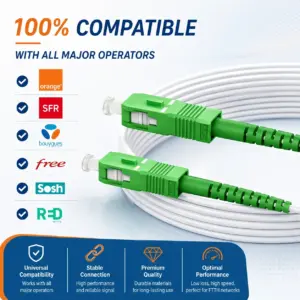
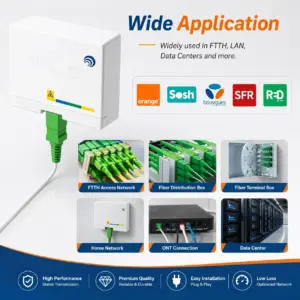
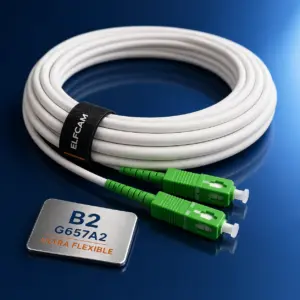
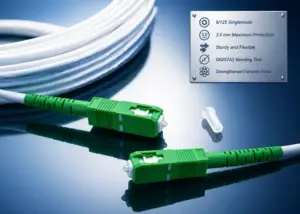
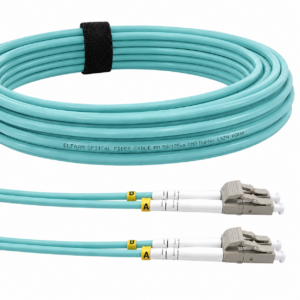
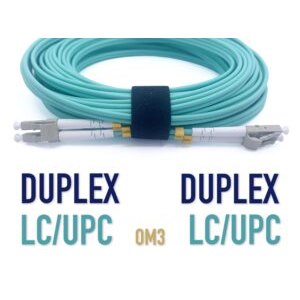
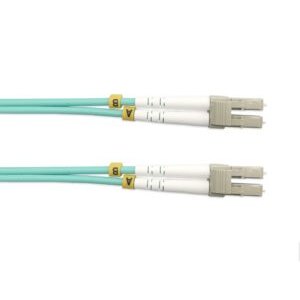
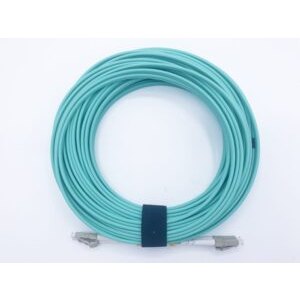
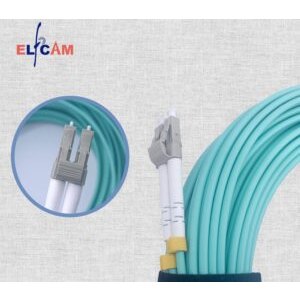
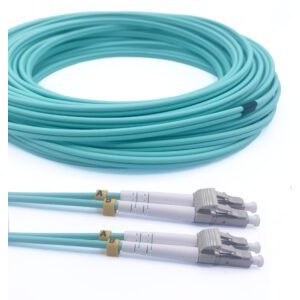
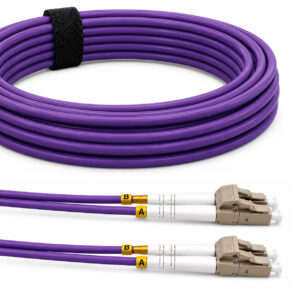
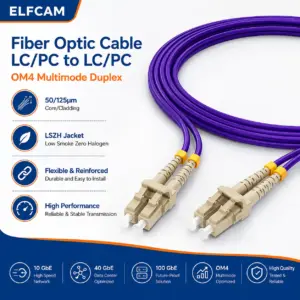
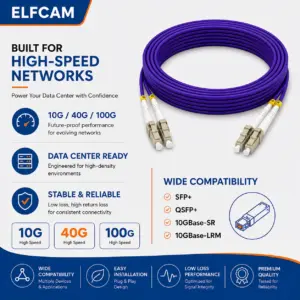
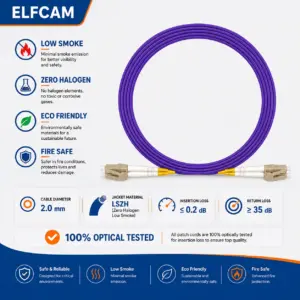
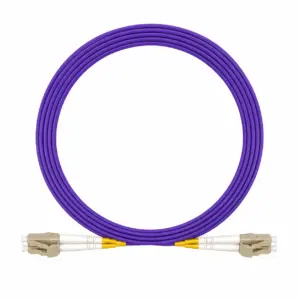
- OS2 fiber cables + SC/APC patch cords — complete FTTH and datacenter range
- SFP/SFP+/QSFP+ modules — 1G, 10G, 25G, 40G, 100G
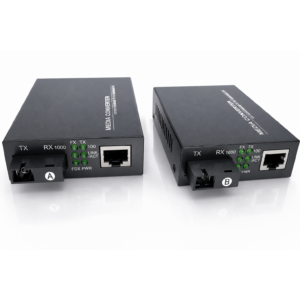
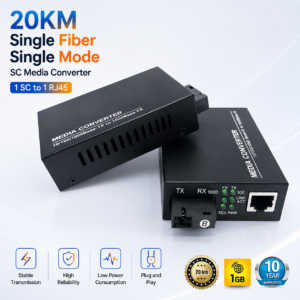
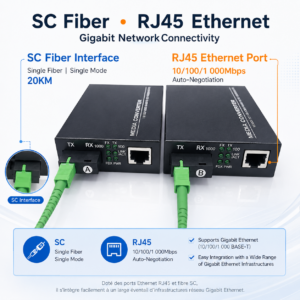
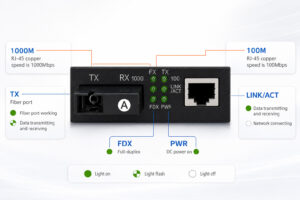
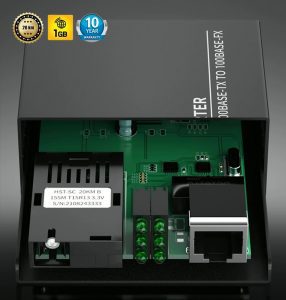
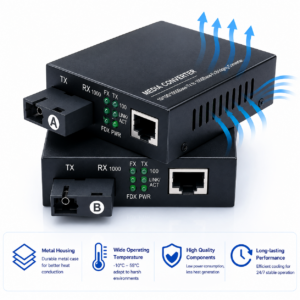
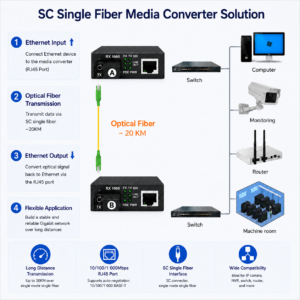
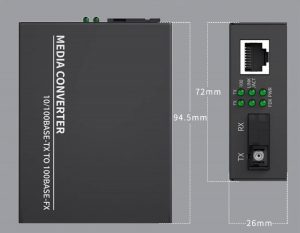
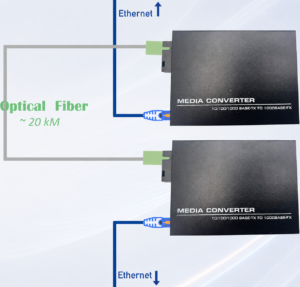
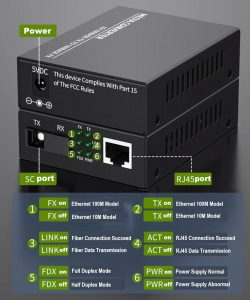
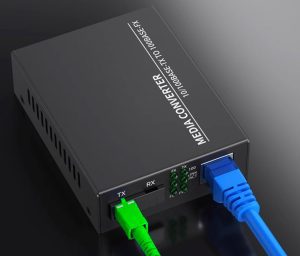
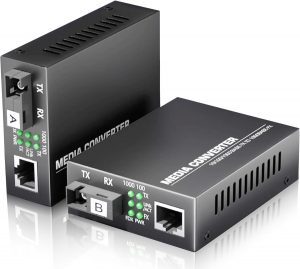
- Fiber/Ethernet converters — for mixed integration
- Ethernet Cat 6/7/8 cables — when copper is enough

FAQ — Optical fiber telecoms
1Is fiber faster than copper?
- Propagation speed: 67% of the speed of light (similar to copper)
- Throughput: up to 400 Gbps+ per fiber vs 10 Gbps max on Cat 8 copper
- Latency: similar but more stable latency on fiber (no EMI bouncing)
2Why does fiber cost more?
3How long does an installed fiber last?
4Can fiber be eavesdropped on?
5When to use single-mode vs multimode fiber?
- Single-mode OS2: long distances (> 2 km), high throughput (10G/100G+), backbone, FTTH
- Multimode OM3/OM4: short distances (< 550 m), intra-rack datacenter, more economical on transmitters (VCSEL)
6What exactly is EDFA?
7Can you run a fiber yourself at home?
- Running a pre-terminated patch cord between your PTO and your box
- Moving an existing PTO via a PTO + cable kit
- Adding length via connection with an adapter (0.3 dB loss)
8Where to buy reliable fiber equipment?
In summary
Optical fiber offers decisive advantages in bandwidth, distance, EMI immunity and security. Its disadvantages (initial cost, fragility, specialized installation) are largely offset for the majority of modern uses.
For your fiber installations, check out our cables and patch cords, SFP/SFP+ modules, converters and adapters in stock in France.