EPON (GEPON) OLT : functions, types and technical specifications
Contents
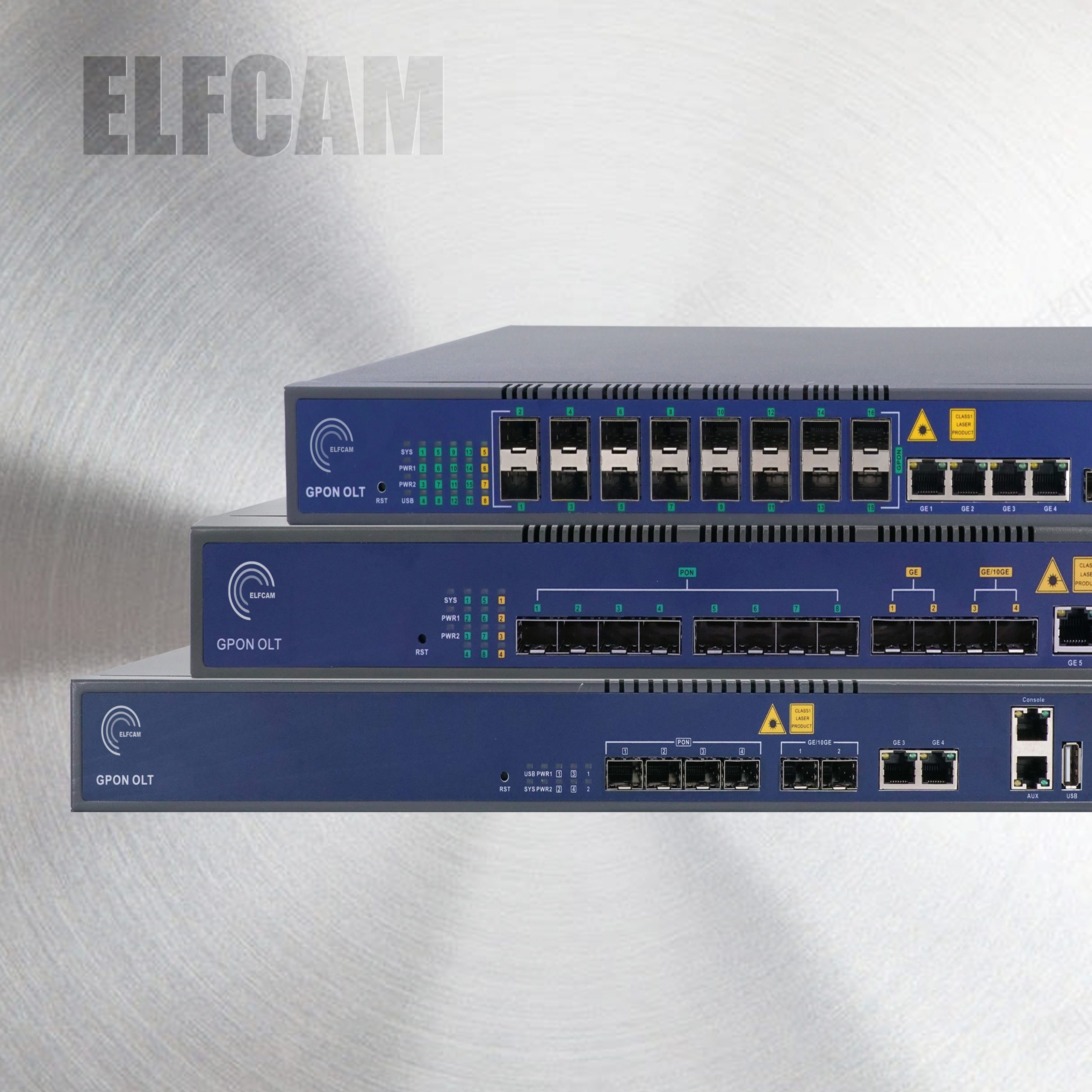
The EPON OLT (Optical Line Terminal) — also called GEPON OLT for its Gigabit version — is the core of a passive FTTH network on the operator side. Installed in the service center, it manages bidirectional communication with several dozen subscriber ONUs/ONTs over a single shared optical fiber.
This guide details the functions of an EPON OLT, its different formats (mini, 4, 8, 16 PON ports), its technical specifications and how to choose the model suited to your campus, hospitality or alternative operator deployment.
What is an EPON OLT ?
In an EPON (Ethernet Passive Optical Network, IEEE 802.3ah) network, the OLT is the centralized active device that emits the downstream optical signal and receives the upstream signals from all subscribers via passive optical splitters (1×32, 1×64 or 1×128).
Three essential components of an EPON FTTH network :
- OLT — operator central, manages up to 128 subscribers per PON port
- PLC splitter — passive optical network without power supply, divides the signal (1×32, 1×64)
- ONU / ONT — customer terminal, converts the signal into usable Ethernet
The OLT is the only active element (electrically powered) between the operator center and the subscribers. It is this passive architecture that makes FTTH economical at large scale.
The 2 main functions of the EPON OLT
| Function | Description |
|---|---|
| Electrical ↔ optical conversion | Translates the Ethernet signals from upstream equipment into light signals for the fiber (and vice versa) |
| TDMA multiplexing management | Coordinates the transmission time windows of the ONUs/ONTs to avoid collisions on the shared fiber |
In practice, the OLT also :
- Authentication of ONUs by serial number or MAC
- Automatic provisioning (auto-provisioning) of subscriber profiles
- QoS to prioritize VoIP, IPTV, data
- VLAN to isolate services (Internet, TV, telephony)
- Optical monitoring (Rx power, distance, status)
Types of EPON OLT (mini, 4, 8, 16 ports)
EPON OLTs come in 4 main categories according to the number of PON ports (each PON port = 1 shared fiber to up to 128 subscribers via splitter) :
| OLT type | PON ports | Max subscribers (ratio 1:64) | Typical use |
|---|---|---|---|
| Mini OLT | 1-2 | 128 | Hotels, small campuses, test lab |
| 4-port OLT | 4 | 256 | Multi-dwelling buildings, large-capacity campsites |
| 8-port OLT | 8 | 512 | Residential neighborhoods, universities |
| 16-port OLT | 16 | 1024 | Urban alternative operator, mid-sized towns |
| 10U+ chassis OLT | 32+ | 2048+ | National operator, metropolis |
Typical technical specifications
| Parameter | Typical EPON value |
|---|---|
| Standard | IEEE 802.3ah (1G-EPON) or 802.3av (10G-EPON) |
| Download rate | 1.25 Gbps (EPON) or 10 Gbps (10G-EPON) |
| Upload rate | 1.25 Gbps (EPON) or 1/10 Gbps (10G-EPON) |
| Download wavelength | 1490 nm |
| Upload wavelength | 1310 nm |
| Max OLT ↔ ONU distance | 20 km (standard), 40 km (extended) |
| Splitting ratio | 1:32 or 1:64 (sometimes 1:128) |
| Optical budget | 29 dB (PX20+ class B+) |
| PON connector | SC/PC or SC/APC |
| Uplink interface | 1G/10G/25G SFP/SFP+ Ethernet |
| Power supply | 220V AC or -48V DC (telecom) |
| Format | 19" rack 1U, 2U or 10U+ chassis |
PX20+ optical budget: what you need to know
A PX20+ class EPON OLT delivers a Tx power ≥ +3 dBm and accepts an Rx power ≥ -27 dBm. A 29 dB optical budget covers : 20 km of fiber (0.35 dB/km × 20 = 7 dB) + 1:32 splitter (17 dB) + connections (3 dB) + margin (2 dB).
Complete EPON network architecture
A typical EPON deployment :
- OLT in technical rack (operator central or campus technical room)
- Uplink to core switch via SFP+ 10 Gbps
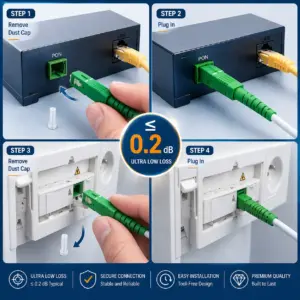
- PON port → SC/APC patch cord to patch panel
- Patch panel → OS2 single-mode fiber to distribution zone
- PLC splitter 1×32 or 1×64 (outdoor PBO enclosure or indoor cabinet)
- Individual fibers → PTO of each subscriber
- PTO → patch cord → customer ONU/ONT
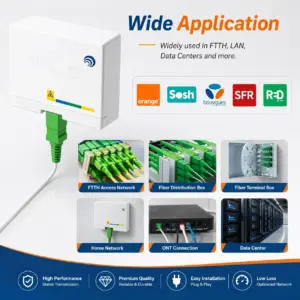
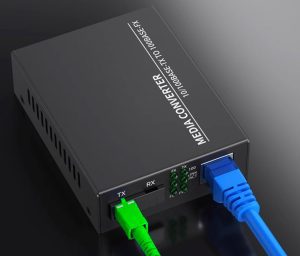
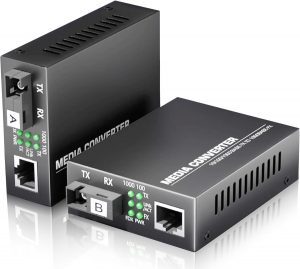
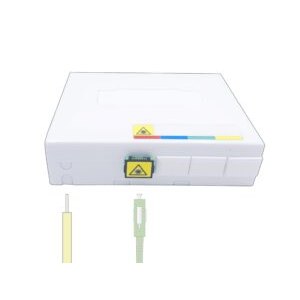
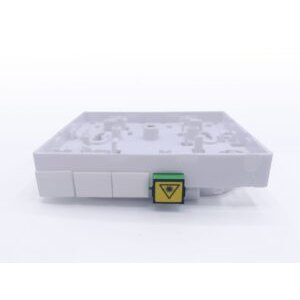
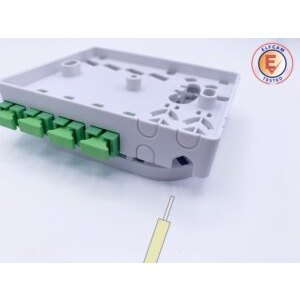
Elfcam components for FTTH EPON deployment
- PLC splitters 1×2, 1×4, 1×8, 1×16, 1×32, 1×64
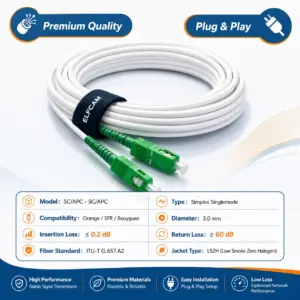
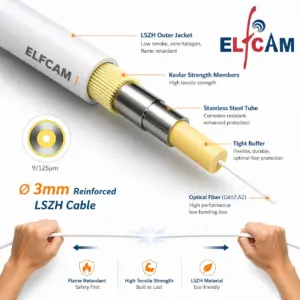
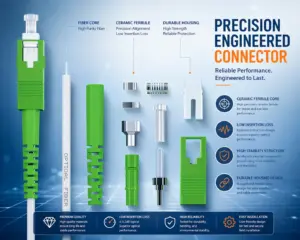
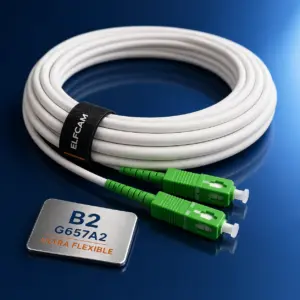
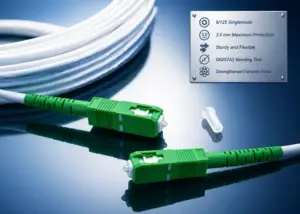
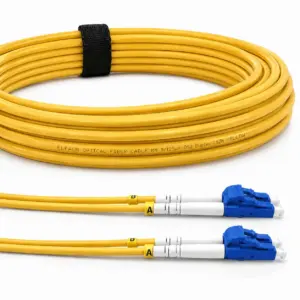
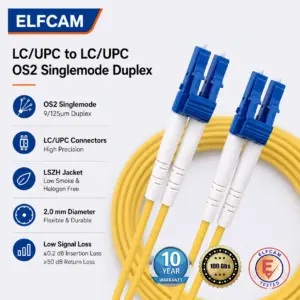
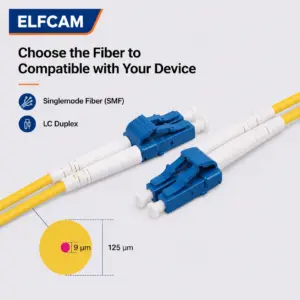
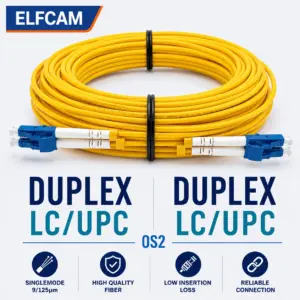
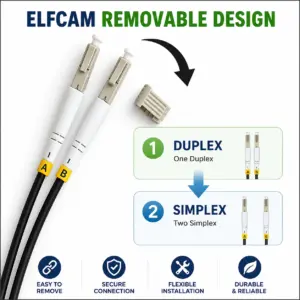
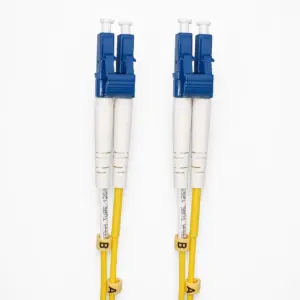
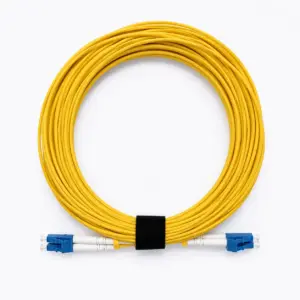
- OS2 single-mode fiber cables + SC/APC patch cords
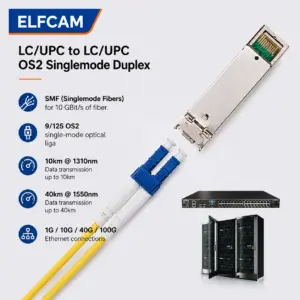
- SFP/SFP+ modules for OLT uplink
- 19" racks and ODF optical drawers for integration
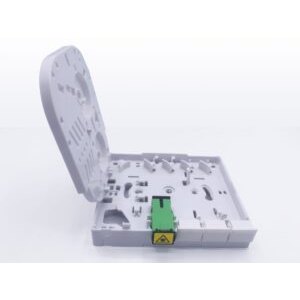
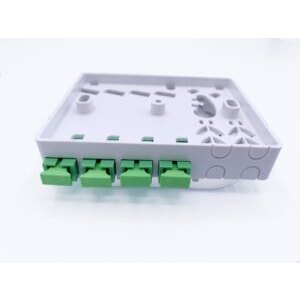
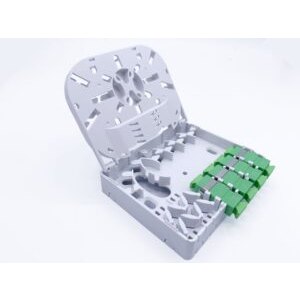
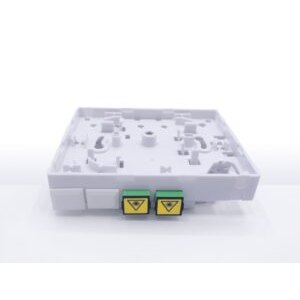
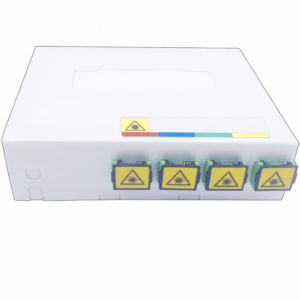
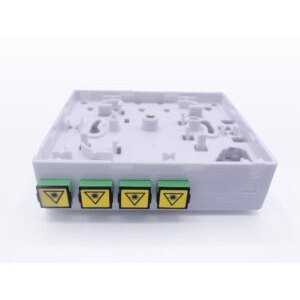
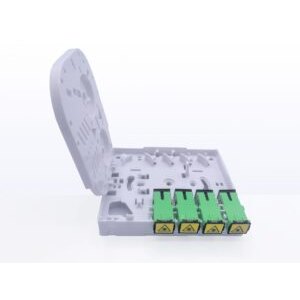
- PTO terminal outlets on the subscriber side



How to choose your EPON OLT ?
- Expected number of subscribers (current + 3 years) → determines the number of PON ports needed
- Offered rate — 1G (classic EPON) or 10G (10G-EPON) according to market expectations
- Splitting ratio — 1:32 balances quality/density, 1:64 maximizes density but is more sensitive to saturation
- Operator ↔ subscribers distance — standard OLT 20 km, extended 40-60 km
- Rack format — mini for hotel/campus, 1U/2U rack for local operator, chassis for city
- Chipset — Broadcom, Cortina, ZTE depending on targeted ONU compatibility
- Management — Cisco-like CLI, web GUI, SNMP, TR-069, NetConf/YANG
Basic installation and configuration
- 19" rack mounting (1U-2U for compact OLT)
- Power supply — 220V outlet or -48V DC bus if telecom room
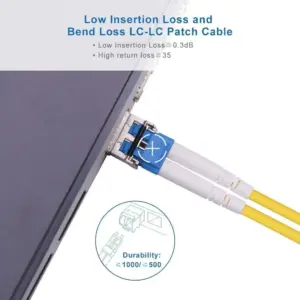
- Network uplink — connect the SFP+ ports to the core switch via LC/UPC patch cords
- Management configuration — management IP, admin password, CLI or web access
- Creation of PON profiles — bandwidth, VLAN, multicast, QoS
- ONU registration — auto-learning or manual by serial number
- Link test — Rx/Tx verification, ONU ping, throughput test
FAQ — EPON / GEPON OLT
1Difference between EPON OLT and GPON OLT ?
GPON (ITU-T G.984) : 2.488 Gbps down / 1.244 Gbps up, GEM encapsulation, more efficient in error tolerance. The two are incompatible : an EPON OLT cannot drive a GPON ONT. For a new deployment in 2024+, favor XGS-PON (10G symmetrical) or 10G-EPON.
2How many subscribers per PON port ?
- 1:32 for premium comfort (35-40 Mbps average per subscriber at peak hour)
- 1:64 for a balanced density/quality ratio (15-20 Mbps average)
- 1:128 only for low-activity subscribers or 10G-EPON
3Mini OLT vs pro OLT : what difference ?
Pro OLT (4-16 ports) : 1U/2U rack, advanced CLI, SNMP, full VLAN, link aggregation. For alternative operators or large campuses. Price 1500-8000 €.
4What consumption for an 8-port OLT ?
5Can 1G-EPON and 10G-EPON be mixed on the same OLT ?
6Which uplink to use with an OLT ?
7Third-party ONU compatibility with Elfcam OLT ?
8Technical support and OLT training ?
- Assisted initial configuration (via TeamViewer or on site)
- Product training (1 day online, 2 days on site)
- Premium support 24/7 via dedicated contract
In summary
The EPON OLT is the active core of a passive FTTH network. Choice based on : number of PON ports (1-16+), rate (1G / 10G), splitting ratio (1:32 / 1:64 / 1:128), distance and rack format.
Check out our PLC splitters, SFP+ modules and OS2 fiber cables to assemble a complete EPON deployment. For operator projects, contact our team via Support.